Showing posts with label smooth. Show all posts

Euonymus obovatus -- Running Strawberry Bush

Native

Other names: Running Euonymus


Chris Evans, Illinois Wildlife Action Plan [6]

John Zaborsky [3]

John Zaborsky [3]

Greg Vaclavek [3]

[1]


Notes:
See USFS National Seed Laboratory Woody Seed Manual  (D & E genera) for a picture of the seed.

Flowering dates: April through June

Fruit ripening dates: August through October

References:


(Numbers in photo captions are photo credits, listed in the "Photo Credits" tab at the top of the page)

Buxus sempervirens -- Boxwood

Non-native (Europe, Western Asia, Northern Africa)


Other names: Common Box, English Boxwood, European Box


Maurice Reille [9]

John Ruter, University of Georgia [2]

[9]

John Ruter, University of Georgia [6]

Wouter Hagens [9]

[1]

Notes:
Not currently found in Michigan. This species is non-native to North America, but is not yet found to be invasive.

References:


(Numbers in photo captions are photo credits, listed in the "Photo Credits" tab at the top of the page)

Asparagus officinalis -- Garden Asparagus

Non-native (Northern Africa, Western Asia, Central to Southeastern Europe)

Other names:  Common Asparagus, Garden Asparagus

Jose Hernandez @ USDA-NRCS PLANTS Database [1]
Excellent seed photo here; note micropunctate surface (which puckers when dry)

Christopher Noll [3]


[1]

Notes:
Although A. officinalis is not native to North America, it is not considered invasive.

References:


Updated 2019


(Numbers in photo captions are photo credits, listed in the "Photo Credits" tab at the top of the page)

Ilex verticillata -- Winterberry

Native

Other names:  Michigan Holly

[8]
Photo by Dave Calder at Flickr under a Creative Commons license

Photo by "Nacho 13" at Flickr under a Creative Commons license

[1]
Notes:
A deciduous holly; requires a male to pollinate females in order to set fruit.

References:


(Numbers in photo captions are photo credits, listed in the "Photo Credits" tab at the top of the page)

Euonymus atropurpureus -- Eastern Wahoo

Native

Other namesEuonymus atropurpurea, Burning Bush, Indian Arrow Wood

[8]
[4]
[7]
[7]
[1]


Notes:
E. atropurpureus is similar to E. americanus, which is found south of Michigan. Both species native to North America can be distinguished from the non-native E. alatus (Burning Bush, Winged Euonymus) by the presence of a winged stem on the latter.

See identification tips and distinguishing E. atropurpureus from other Euonymus in Mistaken Identity? Invasive Plants and their Native Look-alikes: an Identification Guide for the Mid-Atlantic (PDF) by the New York Botanical Garden. 
References:


(Numbers in photo captions are photo credits, listed in the "Photo Credits" tab at the top of the page)

Vitis spp. -- Grapes

Native 


Vitis riparia [8]

[1] Vitis riparia -- Riverbank Grape (most common species in Michigan)

[1] Vitis aestivalis -- Summer Grape, Pigeon Grape

[1] Vitis vulpina -- Frost Grape, Winter Grape

[4] Vitis riparia -- Riverbank Grape

Vitis aestivalis -- Summer Grape, Pigeon Grape
[Mary Keim, Flickr, under a Creative Commons license]

[1] Vitis vulpina -- Frost Grape, Winter Grape


Notes:
Numerous grape species are used by birds and other wildlife. The three species shown above are the Michigan natives (see this key to the species at Michigan Flora online), and found over most of eastern North America. Female plants produce fruit, and usually the vines need to reach a sunny position before flowering and fruiting.

See identification tips and distinguishing Vitis from Ampelopsis brevipedunculata (Porcelain Berry) in Mistaken Identity? Invasive Plants and their Native Look-alikes: an Identification Guide for the Mid-Atlantic (PDF) by the New York Botanical Garden.

Seeds are very similar, and grape seeds have been found to be present in fecal samples in birds at the Rouge River Bird Observatory, Dearborn, MI. The seeds are also very similar to those of related Parthenocissus species; see this page for information on how to distinguish the seeds of these genera.

Mean fruit diameter: 8.40 mm (n=239); mean number of seeds per fruit: 2.02 (n=200), based on samples collected at the Rouge River Bird Observatory, Dearborn, MI. 

References:


(Numbers in photo captions are photo credits, listed in the "Photo Credits" tab at the top of the page)

Taxus spp.-- Yews

Non-native (Europe and Asia)

Two yews are commonly cultivated: T. cuspidata (Japanese Yew, Spreading Yew) and T. baccata (English Yew, Common Yew), as well as a hybrid between the two.

Taxus sp. [8]

[1] T. baccata

[1] T. cuspidata

[4] Typical fruit
[1] T. baccata

[1] T. cuspidata


Notes:
While yews are not often found naturalized in Michigan, birds do frequently utilize cultivated shrubs, including small birds that struggle but eagerly consume the large fruit (arils). A native yew, T. canadensis, is a lower-growing shrub with more flattened leaves growing in a single plane; aril is similar.

Fruit ripening dates: August through October

Seed dispersal dates: August through October

Seeds present in fecal samples in birds found at the Rouge River Bird Observatory, Dearborn, MI.

References:


(Numbers in photo captions are photo credits, listed in the "Photo Credits" tab at the top of the page)

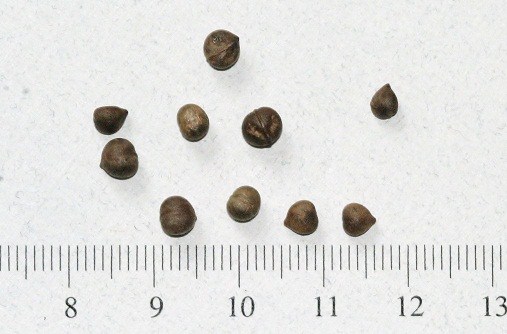
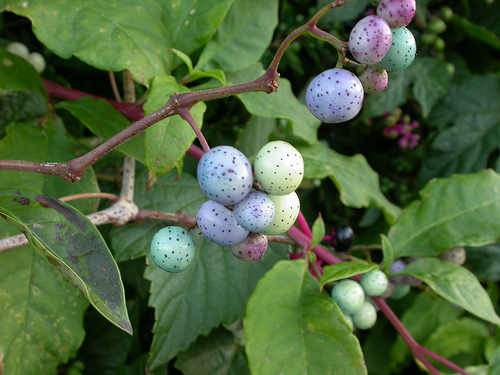
Ampelopsis brevipedunculata -- Porcelain Berry

Non-native* (Japan and northern China)

Other names:  Amur Peppervine, Porcelain Ampelopsis, Porcelain Vine, Turquoise Berry

[8]

See also Shrubs of Wisconsin, Cofrin Center for Biodiversity

Photo by Donald Hobern on Flickr under a Creative Commons license

[3]
[1]
Notes:
There is also a variegated leaf form of this plant.

Fruit has been found to have particular patterns of pigments that make them especially attractive to birds (see M. Witty, A. Yard, J.L. Kinard and Ruth O. Adekunle, 2010. Ampelopsis brevipedunculata berries are simultaneously attractive to birds and repulsive to mammals. International Journal of Botany 6: 35-40.

See also identification tips and distinguishing Ampelopsis from native grapes in Mistaken Identity? Invasive Plants and their Native Look-alikes: an Identification Guide for the Mid-Atlantic (PDF) by the New York Botanical Garden. 

References:


* Listed as invasive in natural areas by the Invasive Plant Atlas of the United States.

(Numbers in photo captions are photo credits, listed in the "Photo Credits" tab at the top of the page)

Celastrus orbiculatus -- Asiatic Bittersweet

See also Celastrus scandens (American Bittersweet)

Non-native* (Eastern Asia)

Other names:  Oriental Bittersweet, Oriental Staff Vine, Chinese Bittersweet, Asian Bittersweet, Round-leaved Bittersweet


[8]
[4]

[10]
[10, Les Mehrhoff]


[1]

Notes:
C. orbiculatus is a non-native species that may be confused with C. scandens (American Bittersweet) which is native to North America.

Leaves of C. orbiculatus are leathery and rounded, those of C. scandens are pointed.

The fruits of C. orbiculatus are located in the leaf axils (rarely in a terminal panicle) whereas the fruits of C. scandens are located in a terminal panicle. There are usually one to a few flowers/fruits per group, and at least five in C. scandnes. Fruit capsules of C. orbiculatus are usually pale, often yellowish, while those of C. scandens are orange.


C. orbiculatus has more seeds per fruit than C. scandens (which usually has one to three seeds). Seed color of C. orbiculatus is typically paler than that of C. scandens.

See also identification tips in Mistaken Identity? Invasive Plants and their Native Look-alikes: an Identification Guide for the Mid-Atlantic (PDF) by the New York Botanical Garden.  

A late-fruiting species most often distributed by late fall migrants or wintering bird species.  Dioecious; only female plants produce fruit.

Seeds present in bird fecal samples at the Rouge River Bird Observatory, Dearborn, MI.

References:


* Listed as invasive in natural areas by the Invasive Plant Atlas of the United States.

(Numbers in photo captions are photo credits, listed in the "Photo Credits" tab at the top of the page)

Malus spp. -- Crabapple

Native and Non-native*


Malus sp. [8]
Malus coronaria (Sweet crab, native) [1]

Malus ioensis (Prairie crab, native) [1]
Malus baccata* (Siberian Crab, non-native) [1]

Malus angustifolia (Southern crab, native to U.S., perhaps not in Michigan) [1]
Malus floribunda* (Japanese flowering crab, non-native) [1]
[4]
Malus ioensis, photo by Dan Mullen at Flickr under a
Creative Commons license


Notes:
There are native and non-native Malus, but cannot be identified to species by seed alone. Species native to Michigan include M. coronaria and M. ioensis, while non-natives established in the state include M. baccata*, M. prunifolia*, and M. pumila*. Birds also consume planted ornamental crabs, such as M. floribunda*.

Seeds present in bird fecal samples at the Rouge River Bird Observatory, Dearborn, MI.

References:


* Listed as invasive in natural areas by the Invasive Plant Atlas of the United States.

(Numbers in photo captions are photo credits, listed in the "Photo Credits" tab at the top of the page)