Showing posts with label vine. Show all posts

Smilax tamnoides -- Bristly Greenbrier

Native


Other names: Smilax hispida, Chinaroot, Hellfetter


Emmet J. Judziewicz [3]

Les Merhoff / Discover Life [10]

George Yatskievych / Discover Life [10]

[1]

Notes:
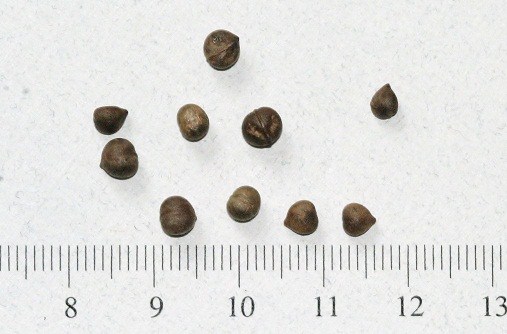
See Missouri Weed Seeds for a photograph of the seeds (labelled Smilax hispida).

References:


(Numbers in photo captions are photo credits, listed in the "Photo Credits" tab at the top of the page)

Smilax rotundifolia -- Roundleaf Greenbrier

Native


Other names: Common Greenbrier

Steve Hurst @ USDA-NRCS PLANTS Database [1]

Steven J. Baskauf [7]

Steven J. Baskauf [7]

Steven J. Baskauf [7]

Franklin Bonner, USFS (ret.) [6]

[1]

Notes: 
Flowering dates: April through June

Fruit ripening dates: Autumn

References:


(Numbers in photo captions are photo credits, listed in the "Photo Credits" tab at the top of the page)

Euonymus obovatus -- Running Strawberry Bush

Native

Other names: Running Euonymus


Chris Evans, Illinois Wildlife Action Plan [6]

John Zaborsky [3]

John Zaborsky [3]

Greg Vaclavek [3]

[1]


Notes:
See USFS National Seed Laboratory Woody Seed Manual  (D & E genera) for a picture of the seed.

Flowering dates: April through June

Fruit ripening dates: August through October

References:


(Numbers in photo captions are photo credits, listed in the "Photo Credits" tab at the top of the page)

Euonymus fortunei -- Wintercreeper

Non-native* (China)


Other names: Fortune's Spindle, Climbing Euonymus


James H. Miller, USDA Forest Service [6]

James H. Miller, USDA Forest Service [6]

Keith Langdon, National Park Service [6]

Steven J. Baskauf [7]

[1]


References:


* Listed as invasive in natural areas by the Invasive Plant Atlas of the United States.

(Numbers in photo captions are photo credits, listed in the "Photo Credits" tab at the top of the page)

Ampelopsis cordata -- Heartleaf Peppervine

Native
 
Other names: Heartleaf Ampelopsis, Raccoon Grape, Possum Grape, False Grape


Steven J. Baskauf [7]


[6]


Robin R. Buckallew @ USDA-NRCS PLANTS Database [1]


[1]


Notes:
See Laboratory Guide to Archaeological Plant Remains for a photograph of the seed.

Native to North America, but not to Michigan.

References:


(Numbers in photo captions are photo credits, listed in the "Photo Credits" tab at the top of the page)

Menispermum canadense -- Moonseed

Native


[1]


William S. Justice @ USDA-NRCS PLANTS Database [1]


[3]


[1]


Notes:
 Flowering dates: May through July

Fruit ripening dates: September through November

References:


(Numbers in photo captions are photo credits, listed in the "Photo Credits" tab at the top of the page)

Rubus occidentalis -- Black Raspberry

Native

Other names: Blackcap raspberry, Thimbleberry


 Steve Hurst @ USDA-NRCS PLANTS Database [1]
Christopher Noll [3]
Merel R. Black [3]
[1]


Notes:
Seeds present in fecal samples at the Rouge River Bird Observatory, Dearborn, MI.

References:


(Numbers in photo captions are photo credits, listed in the "Photo Credits" tab at the top of the page)

Smilax herbacea -- Smooth Carrionflower

Native

Other names:  Jacob's Ladder, Herbaceous Carrion Flower, Carrion Vine


[22]
[22]
[22]
[1]


Notes:
See Missouri Weed Seeds for a photograph of the seeds.

Uncommon in Michigan.

May be confused with S. lasioneura. Both species are herbaceous and lack prickles. Underside of leaf of S. herbacea is glabrous while S. lasioneura is pubescent beneath.

References:


(Numbers in photo captions are photo credits, listed in the "Photo Credits" tab at the top of the page)

Hedera helix -- English Ivy

Non-native* (Europe, western Asia, and northern Africa)

Other names:  Common Ivy

[8]
[4]
[4]
[2]
[1]


References:


* Listed as invasive in natural areas by the Invasive Plant Atlas of the United States.

(Numbers in photo captions are photo credits, listed in the "Photo Credits" tab at the top of the page)

Vitis spp. -- Grapes

Native 


Vitis riparia [8]

[1] Vitis riparia -- Riverbank Grape (most common species in Michigan)

[1] Vitis aestivalis -- Summer Grape, Pigeon Grape

[1] Vitis vulpina -- Frost Grape, Winter Grape

[4] Vitis riparia -- Riverbank Grape

Vitis aestivalis -- Summer Grape, Pigeon Grape
[Mary Keim, Flickr, under a Creative Commons license]

[1] Vitis vulpina -- Frost Grape, Winter Grape


Notes:
Numerous grape species are used by birds and other wildlife. The three species shown above are the Michigan natives (see this key to the species at Michigan Flora online), and found over most of eastern North America. Female plants produce fruit, and usually the vines need to reach a sunny position before flowering and fruiting.

See identification tips and distinguishing Vitis from Ampelopsis brevipedunculata (Porcelain Berry) in Mistaken Identity? Invasive Plants and their Native Look-alikes: an Identification Guide for the Mid-Atlantic (PDF) by the New York Botanical Garden.

Seeds are very similar, and grape seeds have been found to be present in fecal samples in birds at the Rouge River Bird Observatory, Dearborn, MI. The seeds are also very similar to those of related Parthenocissus species; see this page for information on how to distinguish the seeds of these genera.

Mean fruit diameter: 8.40 mm (n=239); mean number of seeds per fruit: 2.02 (n=200), based on samples collected at the Rouge River Bird Observatory, Dearborn, MI. 

References:


(Numbers in photo captions are photo credits, listed in the "Photo Credits" tab at the top of the page)

Ampelopsis brevipedunculata -- Porcelain Berry

Non-native* (Japan and northern China)

Other names:  Amur Peppervine, Porcelain Ampelopsis, Porcelain Vine, Turquoise Berry

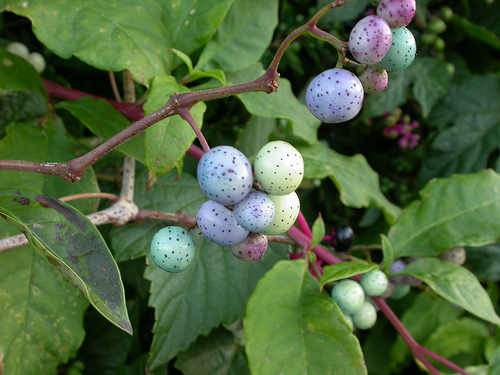
[8]

See also Shrubs of Wisconsin, Cofrin Center for Biodiversity

Photo by Donald Hobern on Flickr under a Creative Commons license

[3]
[1]
Notes:
There is also a variegated leaf form of this plant.

Fruit has been found to have particular patterns of pigments that make them especially attractive to birds (see M. Witty, A. Yard, J.L. Kinard and Ruth O. Adekunle, 2010. Ampelopsis brevipedunculata berries are simultaneously attractive to birds and repulsive to mammals. International Journal of Botany 6: 35-40.

See also identification tips and distinguishing Ampelopsis from native grapes in Mistaken Identity? Invasive Plants and their Native Look-alikes: an Identification Guide for the Mid-Atlantic (PDF) by the New York Botanical Garden. 

References:


* Listed as invasive in natural areas by the Invasive Plant Atlas of the United States.

(Numbers in photo captions are photo credits, listed in the "Photo Credits" tab at the top of the page)