Showing posts with label triangular. Show all posts

Pyracantha coccinea -- Scarlet Firethorn

Non-native* (Southeastern Europe, Himalayas, Central China)


Steve Hurst @ USDA-NRCS PLANTS Database [1]

Robert Vidéki [2]
Robert Vidéki [2]

[1]

Notes:
Not yet found in Michigan.

References:


* Listed as invasive in natural areas by the Invasive Plant Atlas of the United States.

(Numbers in photo captions are photo credits, listed in the "Photo Credits" tab at the top of the page)

Buxus sempervirens -- Boxwood

Non-native (Europe, Western Asia, Northern Africa)


Other names: Common Box, English Boxwood, European Box


Maurice Reille [9]

John Ruter, University of Georgia [2]

[9]

John Ruter, University of Georgia [6]

Wouter Hagens [9]

[1]

Notes:
Not currently found in Michigan. This species is non-native to North America, but is not yet found to be invasive.

References:


(Numbers in photo captions are photo credits, listed in the "Photo Credits" tab at the top of the page)

Actaea pachypoda -- White Baneberry

Native

Other names: Doll's Eyes


William S. Justice @ USDA-NRCS PLANTS Database [1]

Kevin Fulk [3]

[1]


Notes:
See Restoring the Landscape with Native Plants for a photograph of the seed.

References:


(Numbers in photo captions are photo credits, listed in the "Photo Credits" tab at the top of the page)

Vitis spp. -- Grapes

Native 


Vitis riparia [8]

[1] Vitis riparia -- Riverbank Grape (most common species in Michigan)

[1] Vitis aestivalis -- Summer Grape, Pigeon Grape

[1] Vitis vulpina -- Frost Grape, Winter Grape

[4] Vitis riparia -- Riverbank Grape

Vitis aestivalis -- Summer Grape, Pigeon Grape
[Mary Keim, Flickr, under a Creative Commons license]

[1] Vitis vulpina -- Frost Grape, Winter Grape


Notes:
Numerous grape species are used by birds and other wildlife. The three species shown above are the Michigan natives (see this key to the species at Michigan Flora online), and found over most of eastern North America. Female plants produce fruit, and usually the vines need to reach a sunny position before flowering and fruiting.

See identification tips and distinguishing Vitis from Ampelopsis brevipedunculata (Porcelain Berry) in Mistaken Identity? Invasive Plants and their Native Look-alikes: an Identification Guide for the Mid-Atlantic (PDF) by the New York Botanical Garden.

Seeds are very similar, and grape seeds have been found to be present in fecal samples in birds at the Rouge River Bird Observatory, Dearborn, MI. The seeds are also very similar to those of related Parthenocissus species; see this page for information on how to distinguish the seeds of these genera.

Mean fruit diameter: 8.40 mm (n=239); mean number of seeds per fruit: 2.02 (n=200), based on samples collected at the Rouge River Bird Observatory, Dearborn, MI. 

References:


(Numbers in photo captions are photo credits, listed in the "Photo Credits" tab at the top of the page)

Crataegus spp. -- Hawthorn

Native and non-native

Crataegus chrysocarpa (Fireberry Hawthorn, native) [1]
Crataegus crus-galli (Cockspur Hawthorn, native) [1]
Crataegus douglasii (Black Hawthorn, native) [1]
Crataegus phaenopyrum (Washington Hawthorn, native) [1]
 Crataegus phaenopyrum (Washington Hawthorn) [4]
[1] Genus


Notes:
Small to large trees superficially similar to crabapples (Malus) except most with long thorns. Many species are in cultivation of both native and non-native species and their cultivars. They also hybridize readily. See the species accounts at Michigan Flora online for more information on distribution of the species recorded naturalized in the state.

Small-fruited types are most often used by birds, although even the smaller fruits are only suitable to thrush- or robin-sized species. C. phaenopyrum (Washington Hawthorn) is native hawthorns south of Michigan but naturalized here. It is one of the last hawthorns to bloom/fruit and has some of the smallest fruit, eagerly consumed by birds.

Seeds of many species are similar and often cannot be identified to species.

Seeds present in fecal samples in birds at the Rouge River Bird Observatory, Dearborn, MI.

References:


* Listed as invasive in natural areas by the Invasive Plant Atlas of the United States.

(Numbers in photo captions are photo credits, listed in the "Photo Credits" tab at the top of the page)

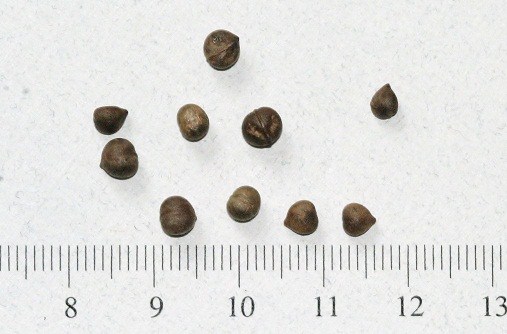
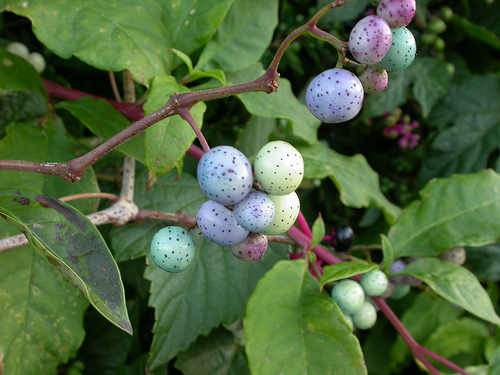
Ampelopsis brevipedunculata -- Porcelain Berry

Non-native* (Japan and northern China)

Other names:  Amur Peppervine, Porcelain Ampelopsis, Porcelain Vine, Turquoise Berry

[8]

See also Shrubs of Wisconsin, Cofrin Center for Biodiversity

Photo by Donald Hobern on Flickr under a Creative Commons license

[3]
[1]
Notes:
There is also a variegated leaf form of this plant.

Fruit has been found to have particular patterns of pigments that make them especially attractive to birds (see M. Witty, A. Yard, J.L. Kinard and Ruth O. Adekunle, 2010. Ampelopsis brevipedunculata berries are simultaneously attractive to birds and repulsive to mammals. International Journal of Botany 6: 35-40.

See also identification tips and distinguishing Ampelopsis from native grapes in Mistaken Identity? Invasive Plants and their Native Look-alikes: an Identification Guide for the Mid-Atlantic (PDF) by the New York Botanical Garden. 

References:


* Listed as invasive in natural areas by the Invasive Plant Atlas of the United States.

(Numbers in photo captions are photo credits, listed in the "Photo Credits" tab at the top of the page)

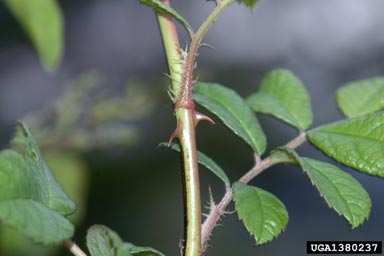
Rosa multiflora -- Multiflora Rose

Non-native* (Asia)

Other names:  Japanese Rose, Rambler Rose

[1]

Seeds: see also Seeds of Wild Plants of Korea

[4]
[4]
[1]
[13]
[13]
[1]

Notes:
Hips small, around 5 mm; usually the smallest-hipped Rosa found in natural areas; native species typically have larger hips. Hips of the also-common native Rosa setigera are slightly larger, but have smaller, more numerous seeds.

See this key at Michigan Flora for all the species of native and non-native Rosa in Michigan, and our overview of the genus Rosa in Michigan.

Seeds present in bird fecal samples at the Rouge River Bird Observatory, Dearborn, MI.

References:


* Listed as invasive in natural areas by the Invasive Plant Atlas of the United States.

(Numbers in photo captions are photo credits, listed in the "Photo Credits" tab at the top of the page)

Parthenocissus tricuspidata -- Boston Ivy

Non-native* (Eastern Asia)

Other names:   Ampelopsis tricuspidata


[8]
Photo by flora.cyclam at Flickr under a Creative Commons license

[3]

[1]


Notes:
Although not established well in the wild in Michigan, it is a common ornamental used by birds.

Fruit ripening dates: September through October

References:

* Listed as invasive in natural areas by the Invasive Plant Atlas of the United States.
(Numbers in photo captions are photo credits, listed in the "Photo Credits" tab at the top of the page)

Parthenocissus vitacea -- Woodbine

See also Parthenocissus quinquefolia (Virginia Creeper). Most fruiting native vines of this genus in the region are actually P. vitacea, although both species occur together.

Native

Other names:   Parthenocissus inserta, False Virginia Creeper, Thicket Creeper 

[8]

[8]

[4]
[4]
[1]


Notes:
The fruiting stem of P. vitacea continuously branches in two, and this species routinely sets fruit. P. quinequefolia (Virginia Creeper) does not set much fruit, and its fruiting stem will have a central axis with shorter stems with fruit branching off.

When not in fruit, these two species can be distinguished by 1) P. quinquefolia is pubescent on the underside of the leaf, while P. vitacea is glabrous, and 2) the tendrils of P. quinquefolia end in discs, enabling the vine to cling to flat surfaces, while P. vitacea can only climb by winding its tendrils on objects.

Seeds of the two species are probably not distinguishable.

Fruit ripening dates: July through October

Seed dispersal dates: August through February (although eagerly consumed and few tend to remain)


Seeds present in bird fecal samples at the Rouge River Bird Observatory, Dearborn, MI.

References:


(Numbers in photo captions are photo credits, listed in the "Photo Credits" tab at the top of the page)

Parthenocissus quinquefolia -- Virginia Creeper

See also Parthenocissus vitacea (Woodbine). Most fruiting vines of this genus in the region are actually P. vitacea, although both species occur together.

Native

Other names:   Five-leaved Ivy, Five Finger, False Grape 

[1]

Steven Baskauf, Bioimages [7]
[4]

Adhesive discs [4]
[1]


Notes:
Typically, P. quinequefolia does not set much fruit. The fruiting stem will have a central axis with shorter stems with fruit branching off. The fruiting stem of P. vitacea continuously branches in two.

When not in fruit, these two species can be distinguished by 1) P. quinquefolia is pubescent on the underside of the leaf, while P. vitacea is glabrous, and 2) the tendrils of P. quinquefolia end in discs, enabling the vine to cling to flat surfaces, while P. vitacea can only climb by winding its tendrils on objects.

Seeds very similar to related grapes (Vitis spp.). See this page for information on how to distinguish these seeds.

Fruit ripening dates: July through October

Seed dispersal dates: August through February

References:

(Numbers in photo captions are photo credits, listed in the "Photo Credits" tab at the top of the page)